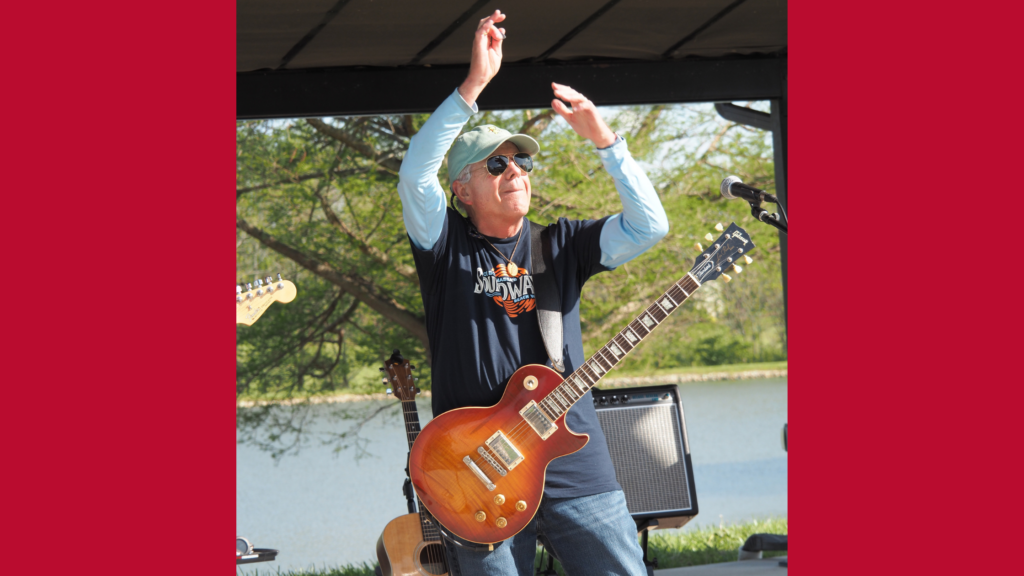
Chuck Michel is no stranger to a cancer diagnosis.
An avid music lover, guitarist and trade show marketing executive, Michel enjoys traveling with his wife, Suzanne, and planning trips around concerts and music festivals. In early 2024, cancer wasn’t something he expected to think about again. After successfully overcoming skin cancer and lung cancer years earlier and remaining diligent about his annual physical exams, a routine blood test brought cancer to the forefront a third time.
His prostate-specific antigen (PSA) level had risen.
Following his primary care physician’s recommendation, Michel met with R. Sherburne Figenshau, MD, a urologist at WashU Medicine, who recommended an FDA-approved blood test that gives patients and providers a clear, personalized probability of finding aggressive prostate cancer on biopsy.
“The test came back questionable,” Michel recalled. “Dr. Figenshau recommended an MRI, which we did. It confirmed something was going on. At that point, we decided to do a biopsy.”
The biopsy confirmed localized prostate cancer with a Gleason score of 6. The score indicated a low-grade, slower-growing cancer. “The standard protocol was to monitor my PSA levels moving forward. And that’s what we did. It did go up, but it hadn’t changed much. At the one-year mark, we did another biopsy, which is routine when you have this diagnosis. This time, the results were surprising – Gleason score of 9,” Michel said.
This aggressive growth meant immediate treatment was required. Michel and his wife met with community specialists to discuss a standard of care approach – weeks of radiation therapy, possibly followed by hormone therapy.
They were all prepared to move forward with that plan, until an unexpected conversation changed everything.
The Kentucky Derby conversation
At a neighborhood Kentucky Derby party, Michel mentioned his diagnosis to friends and members of his pickleball group. One friend casually asked, “Well, have you talked to Diane about this?” Michel answered no, and she promptly texted fellow pickleball player Diane Bender, PhD, a lead scientist at WashU Medicine’s Bursky Center for Human Immunology and Immunotherapy.
“It was one of those moments when you realize you never know who is in your life for a reason,” Michel recalled. “Diane said she was going to talk to her colleague, Russell, whom I didn’t know. Diane quickly called me back and connected me with Russell.”
Russell K. Pachynski, MD, a physician-scientist in the Division of Oncology, spoke on the phone with Michel and Suzanne, explaining emerging treatment options, including an early-phase immunotherapy clinical trial available through Siteman Cancer Center, based at Barnes-Jewish Hospital and WashU Medicine, for patients with localized, non-metastatic prostate cancer. The clinical trial combined targeted immunotherapy – with a new class of drugs called “T cell engagers” that bind the tumor and the killer immune cells – before removing the prostate, eliminating the need for radiation. They met in person to discuss the trial further and Michel’s eligibility.
“Dr. Pachynski told me – and this phrase stuck with me – this trial and surgery would give me two shots on goal,” Michel recalled. “Radiation generally cannot be repeated, so it would still be an option for me in the future to take ‘another shot’ at the cancer if it came back.”
The last step was to meet with WashU Medicine urologist and surgeon Sam Bhayani, MD, who would perform a robotic prostatectomy to remove the prostate gland following the infusions. Michel remembers the meeting fondly: “As we were waiting for our appointment, Dr. Bhayani stuck his head in quickly and said, ‘I will be right with you, Chuck. Don’t worry, I already know all about you.’ And he did. He put us at ease immediately as he talked us through the procedure and recovery. I felt there was no stone left unturned in terms of needing any more information to make the decision. Every question or concern we had was answered and addressed thoroughly.”
After additional imaging and a multidisciplinary review confirmed he was indeed eligible, Michel enrolled in the clinical trial.
Exceptional care team
Michel began treatment in early June 2025. He received eight cycles of immunotherapy as part of the trial, first during a monitored hospital stay and then through outpatient infusions. While he experienced flu-like fatigue and soreness during treatment, he found the side effects manageable and was grateful for the exceptional care he received from the Siteman team. Mark Sundermeyer, MD, cancer oncologist, and Lisa Resnik, clinical research coordinator, oversaw the treatment process, which was completed in about five weeks.
Next, Michel underwent robotic prostate surgery in late July 2025 at Barnes-Jewish West County Hospital. Recovery progressed smoothly, thanks to the detailed explanations before surgery and follow-up care received. He was able to return to work and activities as planned, including resuming concert travels with Suzanne.
“I knew the treatment was successful from the fact that Dr. Bhayani said he really liked what he saw in my tests following surgery. Everything ‘looks good,’ so to speak,” Michel shared.
“Chuck has had state-of-the-art treatment from Siteman Cancer Center, and with regular testing, we are cautiously optimistic that he will continue to win this battle with prostate cancer,” Bhayani said.
“Being a cancer survivor already, I know the next five years are critical. We’ll be monitoring my progress closely as part of the trial,” Michel explained. “I’m grateful to everyone involved in my patient journey.”
Connections matter
Participating in a clinical trial wasn’t just about his own treatment. Michel hopes the information gathered from his experience will help researchers develop better therapies for prostate cancer.
“If somebody asked me today, I’d absolutely encourage them to look into a clinical trial if they are eligible,” Michel said. “I’m happy to share what I learned and help connect people with the right resources like Diane did for me for more information.”
For Michel, the journey reinforced something he has always believed: connections matter.
Whether it’s the physician who catches an abnormal screening result, the neighbor who asks a question at a Derby party, a skilled surgeon and their team, or the researchers working to advance cancer treatment, every connection made a difference in Michel’s patient journey.