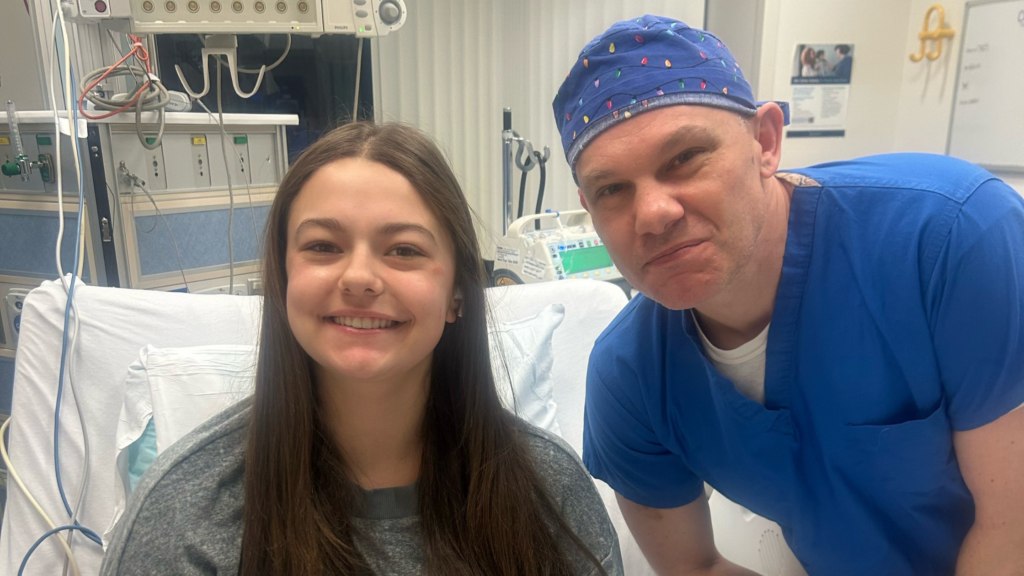
For most people, sweating is a normal part of life. But for Azra Pervan, now 15, excessive sweating, a condition known as hyperhidrosis, controlled nearly every part of her life. She began experiencing symptoms at age five when her family noticed the excessive sweating of her palms and feet.
“When she started kindergarten, we thought it was a normal reaction to being nervous or when she was having a rough day,” her mother, Alisa Hot, recalled. “As she got older, it became clear this was not normal sweating—it continued to worsen and significantly affected her daily life.”
“I would leave a trail through the house of wet feet,” Azra said with a smile. “You’d know if I went to the closet, the kitchen or my room! My hands were like a leaky faucet—dripping sweat constantly. I had trouble writing at school as the ink would smear. I’d have to fold the paper over and over again to finish assignments. I would bring washcloths to school and wear long sleeves to dry my hands.”
The family worked with Azra’s pediatrician to manage her condition. Around fourth grade, they saw a dermatologist for solutions. “I tried different medications such as Glycopyrrolate, Ditropan and Qbrexza. Then, we moved on to topicals and hand wipes. When these didn’t work, we tried an ion machine. It sent electric shocks through my nerves to try to block the sweating,” Azra explained.
“She would have to do the shocks every day on her hands, feet, armpits—wherever she wanted to stop the sweating. She could adjust the shock waves, but it wasn’t comfortable. Azra would get burns, sores and callouses on her skin because the frequency was so high. If she stopped the treatments for a few days, the sweat would just come back,” Alisa said. “It was so frustrating.”
The hyperhidrosis was also affecting Azra socially: “I didn’t want to explain it to people, so I kept my condition private. Only my close friends knew what I was going through. It was hard in school when we did activities that involved touching hands or giving each other high-fives. I tried out for volleyball but didn’t make the team because my hands were so sweaty I couldn’t handle the ball.”
Her mom was at her wits’ end, and high school was fast-approaching in the fall. “I kept thinking, there has to be a solution. I scrounged the internet and finally found a cardiothoracic surgeon in California who ran a hyperhidrosis clinic. I watched every video he had and scheduled an online consultation so we could talk to him about the surgical options. We figured there had to be someone in St. Louis who could do the surgery Azra needed—and there was!”
Jacob Miller, MD, a WashU Medicine pediatric cardiothoracic surgeon at St. Louis Children’s Hospital, met with the family for a consultation in July 2025. During their appointment, Dr. Miller listened closely, examined Azra’s symptoms, and discussed the possibility of surgical treatment through bilateral sympathectomy.
“For patients with medically refractory hyperhidrosis, the impacts on their daily life can be profound. Azra is an honor student and volleyball player with high aspirations. Her hyperhidrosis was very limiting,” Dr. Miller shared. “Bilateral sympathectomy involves the removal of part of the sympathetic chain (part of the nervous system that helps induce sweating). Using robotic technology and advanced pain control to numb the nerves, this procedure is designed to keep discomfort low so most patients can return home the same day or the next morning.
Though the surgery carries some risks—including pneumothorax (air leaking into the space between the lung and chest wall), droopy eyelid and compensatory sweating—Azra was ready. “She was willing to take all the risks just to live a normal life,” her mother said.
Azra’s first surgery on her left hand was in September 2025 at St. Louis Children’s Hospital. Dr. Miller performed the procedure with Ruben Nava, MD, an adult thoracic surgeon at WashU Medicine. As this is an uncommon procedure in children, it was done as a team with a pediatric cardiac surgeon and an adult thoracic surgeon who performs this procedure often.

Azra experienced immediate improvement after surgery, with resolution of hyperhidrosis on the treated side following the procedure.
“When she woke up, her left hand was completely dry,” her mother said. “She did have a pneumothorax after the first procedure, requiring overnight observation and monitoring, but quickly recovered without long-term complications.”
With her successful outcome, Azra was excited to have surgery on her right, dominant hand in January 2026 with Drs. Nava and Miller. When she woke up, her right hand was completely dry too.
Today, Azra is living a normal life free from hyperhidrosis. “My quality of life is a dream, honestly,” she said. “I can’t explain it. Not having to change clothes, wearing colors, going to school with dry hands, being able to high-five people, play volleyball—it’s amazing. I can walk around my house and not leave wet footprints behind!”
Her confidence has returned, too.
“She used to hide her hands in her sleeves,” her mother said. “Now she shops for cute clothes in all colors, not just black and white! She’s on the volleyball team and enjoying all the social activities without worrying about sweating.”
Azra and her family hope their experience raises awareness regarding the significant burden of hyperhidrosis and the importance of exploring all available treatment options.
“Hyperhidrosis may appear minor to others, but for patients and their families living with this condition, it can be overwhelming,” Alisa said. “Families should know there is a surgical option, even when other treatments have failed. There is hope! We will forever be grateful to Drs. Miller and Nava.”
To make an appointment with a WashU Medicine cardiothoracic surgeon, please visit our website.